Replay the source before reading the interpretation
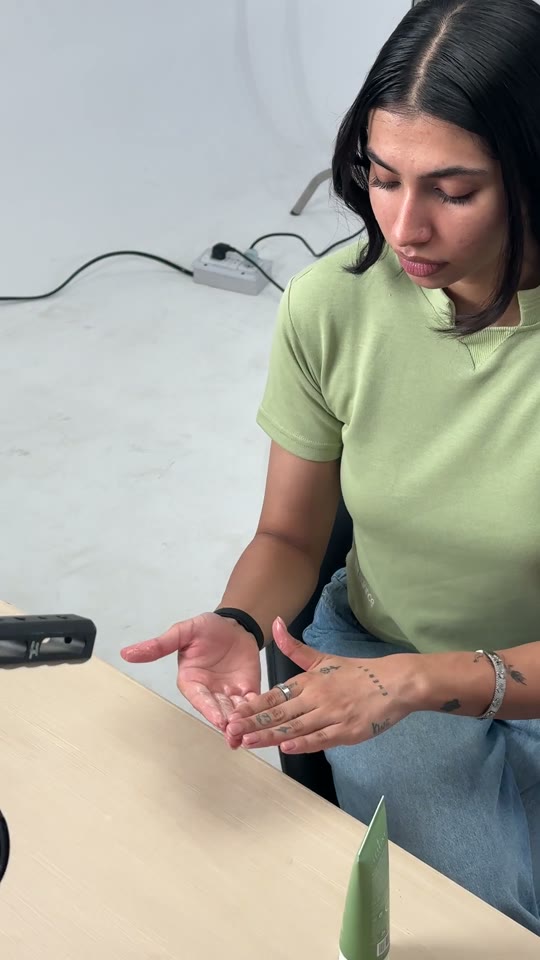
The supplied MP4 is 1080×1920 and lasts 11.066667 seconds. It shows a person at a table with a green tube and a camera operator in the foreground. The file has a video stream and no audio stream. A silent file cannot verify a spoken benefit, music cue or voiceover. Another camera recording of the same production may have different material; it is not part of this sample.
Footage: Ali Jafar, Pexels source 38161399, used under the Pexels license. The source is embedded for analysis and comparison. It is not footage supplied by a customer.
We uploaded this permitted file through the live analyzer, chose Ad intelligence and reviewed the completed on-screen report on October 18. No campaign data, product specification, brand brief or performance figures were supplied. This was a founder demonstration, not a new customer analysis.
Actual generated report
The text in this panel is the real output, with headings and paragraph formatting only. Statements about product type, equipment and audience remain model interpretations. They are not independently established by this page.
Product Identification
The product visible on the table at 00:00 - 00:10 is an upright green cosmetic tube standing with a white cap facing downward. Due to angle and distance, the brand name and exact product labeling cannot be read with certainty, but it appears to be a lotion, hand cream, or skincare product that leaves a white creamy residue on the presenter's hands.
Hook Analysis
00:00 - 00:03: The first three seconds show a behind-the-scenes view of a woman seated at a desk displaying her palms covered in white product toward a camera held by a videographer in the foreground. There is no traditional commercial hook, verbal greeting, or on-screen graphic; the opening captures raw production footage as she shows the product on her hands.
Structure and Pacing
00:00 - 00:03: The woman shows the palms of both hands coated with product toward the camera rig while looking down and slightly speaking without audible dialogue.
00:03 - 00:07: She rubs her hands together on the table surface, spreading the cream across her palms and fingers while the camera operator adjusts framing.
00:07 - 00:10: She finishes rubbing the product and pauses, looking back down at her hands and the camera monitor.
The pacing is continuous, unedited real-time footage of a single take lasting 10 seconds without cuts, scene transitions, or edits.
Product Message
There is no explicit verbal or written product message presented in the video. The implicit demonstration shows the product's application to the skin and its initial white, creamy texture before being rubbed in.
Visual Style
The visual style is a candid, behind-the-scenes, over-the-shoulder perspective. The footage is recorded vertically on a mobile device or secondary camera, capturing both the on-camera talent and the videographer operating a mirrorless camera on a rig. The environment is a studio setting with a plain white wall and floor, studio light stands, power strips, and cables visible in the background.
Audio and Text Elements
Music: There is no music track present.
Dialogue/Audio: The clip contains no audible speech, voiceover, or sound effects; it is silent.
Text Overlays: There are no text overlays, titles, captions, or graphic badges displayed during the video.
Call to Action
There is no call to action present anywhere in the clip, either visually or audibly.
Target Audience
Observable facts: The video displays a young adult female applying a topical skincare product from a green tube in a production setting.
Inferred audience: Viewers interested in skincare, personal grooming products, or social media content creation and production processes.
Evaluation of Elements and Potential Improvements
Effectiveness cannot be determined from this footage alone, as this is an unedited behind-the-scenes recording rather than a finished commercial advertisement.
Observable areas for improvement to function as a finished advertisement:
1. Product Clarity: Introduce clear close-up shots of the product label so the brand and product function can be recognized.
2. Narrative and Structure: Edit raw footage into a structured format containing an introductory hook, demonstration, and conclusion rather than an unbroken behind-the-scenes angle.
3. Audio: Add clear dialogue, voiceover, or background music to communicate product benefits.
4. On-Screen Graphics: Incorporate text overlays detailing key ingredients, results, or pricing.
5. Call to Action: Add a direct prompt guiding viewers on where or how to purchase the product.
A qualitative Hook Scorecard, checked by an editor
The following is a separate human review of the opening and the supplied file. It is not an extra product-generated section or a numeric score. Our rubric asks whether each field is observable, unconfirmed or unavailable. Missing evidence stays missing.
| Review field | What can be checked here | What remains unresolved |
|---|---|---|
| Opening promise | No written promise is visible in the reviewed opening. The source file has no audio track. | A spoken or off-camera promise cannot be reconstructed from this file. |
| Visible proof | Hands, visible residue and a green tube appear in the picture. | The exact product, its ingredients, its benefit and the cause of the residue are not confirmed. |
| Transitions and pacing | The opening presents a continuous view while the person and camera move. | The generated ranges are not a verified list of edits. Replay before using a range in an edit decision. |
| Audible beats | File inspection confirms there is no audio stream. | No statement about speech, music or sound in another recording is supported. |
The report's description of a cosmetic or skincare product is plausible wording, but the label is not readable enough to establish the identity. Likewise, its reference to a mirrorless camera is an equipment interpretation, not verified camera metadata. Those details should remain unconfirmed in a client brief.
Turn the report into a testable edit brief
Editorial hypothesis: if this material is intended for a finished product ad, make one intended claim explicit and show evidence relevant to that claim. Do not treat visible application as proof of a benefit. Request the approved product identity and the evidence that supports the intended statement before writing benefit copy.
An editor could propose a clearly readable product shot, retain the action that explains use, then give the viewer one next step. These are proposed changes, not measured improvements. The source here is behind-the-scenes footage; the fact that it lacks a finished-ad structure does not make the production unsuccessful.
Write the brief in three separate parts: the exact generated excerpt you used, the source observation you checked and the edit you want to test. Record the source filename and version, the approximate replay range, the proposed change, the review owner and the result after testing. If performance data is absent, write “Not measured” rather than predicting a conversion lift.
Google's ABCD creative guidance provides questions about attention, branding, connection and direction. It does not turn this untested source into a proven ad. For objective product claims, the FTC's substantiation policy describes the need for a reasonable basis before dissemination. This sample report supplies neither product testing nor a compliance determination.
Use our product-demo audit guide and manual proof worksheet to record evidence gaps. The creative brief handoff guide explains how to separate observations from editorial requests; the Hook Scorecard guide provides a fuller qualitative review workflow.
What this sample cannot tell you
- No ad spend, campaign identifier, targeting, impression count, retention, clicks or payments were supplied.
- The depicted people and product do not endorse AdScanVideo. The clip is licensed stock, not a testimonial.
- The source has no audio track. A transcript or spoken promise cannot be recovered from absent audio.
- The report's duration and ranges are approximate. Some descriptions and inferences require correction or confirmation.
- No new edit was tested. There is no measured benefit, accuracy percentage, hook score or conversion improvement.
Read our methodology and limitations and the source-verification guide before treating an AI report as a deliverable. The useful outcome is a clearer review task, not a replacement for watching the recording.
Frequently asked questions
Is this a successful or winning ad?
No. This is licensed behind-the-scenes footage, not a documented campaign. The report cannot establish spend, conversions, product efficacy or a winning creative.
Why does the report end at 00:10 when the file is about 11 seconds?
The source file lasts 11.066667 seconds. The generated report describes ranges ending at 00:10 and calls the take 10 seconds. Preserve that discrepancy and replay the original; these are approximate report times, not verified edit boundaries.
Does the clip contain dialogue or music?
The supplied source file has no audio track. The report therefore cannot establish a spoken promise or audible beat from this file. This says nothing about other recordings of the same production.
Can I use this report as evidence that the product works?
No. Visible application is not a measured product result. Product identity, benefits and campaign performance need evidence outside this clip.
How do I analyze my own product video?
Upload a video file you own or may analyze and choose Ad intelligence. One daily on-screen report is free without signup, up to 10 minutes and 200 MB. Verify observations against your source.
Review your own product video
Upload a video you own or may analyze and choose Ad intelligence. One daily on-screen report is free without signup, up to 10 minutes and 200 MB. Verified email sign-in enables free watermarked Copy, Word and PDF; one credit removes the watermark for an existing free report without a rerun. Paid analyses include clean exports.
Analyze my product video